A Complete Manual for Conducting International Flight Operations
Equipment Failures
Equipment Failures
Certain equipment failures compromise the ability of the aircraft to proceed in Class II airspace, or to operate in RVSM, or to conduct communications in a given airspace, or to maintain redundancy requirements or navigational accuracy.
Types of Equipment Failures
Navigation Failure
HF Communications Failure
Engine Failure
Pressurization Failure
Medical Emergency
Navigation Failure
A navigation failure could occur for a number of reasons. It could be related to satellite reception or failure or it could be something very simple such as a corrupt database. Regardless crewmembers shall apply the following in response to a navigation failures while in oceanic airspace or enroute to oceanic airspace:
- If one navigation systems fails before the oceanic boundary, the flight crew shall consider diverting to a suitable airport or returning to the departure airport. Diverting to an established special route that does not require multiple navigation systems, i.e. Blue Spruce Routes.
- If one navigation system fails after the oceanic boundary, the flight crew shall assess the situation considering the performance of the remaining system and the distance to travel in MNPS airspace, advise ATC regarding intentions, monitor navigation accuracy closely for failures or descrepancies, monitor TCAS for other aircraft.
- If the remaining navigation system fails, an emergency situation exists and the flight crew has authority to deviate to the extent necessary to meet the needs of the emergency. The flight crew shall initially notify ATC, attempt visual sighting of aircraft contrails, use exterior lighting, consider climbing or descending 500 feet, broadcast intentions on 123.45 and 121.45, and navigate according to the headings and times on the navigation log and flight plan.
HF Communication Failure
- If the HF communication failure occurs prior to the oceanic boundary, consider rerouting to a route where long range communications are not required, advise ATC of the failure, determine SATCOM capability, and monitor 121.5 and 123.45 for aircraft in the surrounding area that would be capable of relaying position reports.
- If the HF communication failure occurs after oceanic entry, the flight crew shall broadcast position on VHF 121.5, 123.45 and shall use PAN-PAN as necessary, attempting to contact other aircraft to help relay present position and failure of the HF system. Consider diverting to an area where HF communication is not required and attempt a SATCOM call to ATC.
Engine Failure
- If the engine failure occurs prior to the oceanic boundary, the flight shall, if within radar contact, establish driftdown airspeed (determined in the FMS on the PERF page, AFM or checklist), divert to the nearest suitable aerodrome, broadcast MAYDAY-MAYDAY or PAN-PAN and intentions on 121.5 and the current ATC frequency, use maximum illumination of aircraft lighting consistent with limitations, squawk 7700, verify local state contingency procedures and complete relevant checklists.
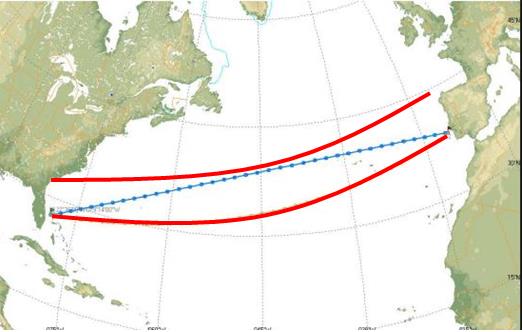 If the engine failure occurs after oceanic entry, the flight shall leave the assigned route or track by initially turning at least 45 degrees to the right or left in order to acquire the same or opposite direction track offset of 15NM. The direction of the turn shall be determined by the distance to the nearest alternate airport, deviation away from tracks, weather at alternate and diversionary airports and SLOP. Consideration shall also be given to flying a DR route which is south of the Great Circle route in the Northern Hemisphere, or a route which is north of the Great Circle route in the Southern Hemisphere. This is due to the fact that DR will be a rhumb line route as opposed to a Great Circle Route. In the photo below the blue line would indicate the Great Circle Route and the red lines indicate a rhumb line route.
- If unable to maintain the assigned flight level, the rate of descent shall be minimized and the pilot shall establish the aircraft at a flight level which differs from standard by 500 feet if below FL410, or 1000 feet if above FL410, i.e. FL405 or FL 440. The flight crew shall alert nearby aircraft on frequency 121.5, 123.45 and the current HF frequency using MAYDAY-MAYDAY or PAN-PAN and advise intentions on 121.5 and the current HF frequency, the flight crew shall use maximum illumination of aircraft lighting consistent with limitations, squawk 7700, verify local state contingency procedures and complete relevant checklists.
Pressurization Failure
- If loss of pressurization occurs prior to the oceanic boundary, don crew oxygen masks, initiate emergency descent, power levers to idle, extend speedbrakes, increase rate of descent until VMO or MMO is reached and use VMO or MMO until reaching desired altitude. Deploy passenger oxygen masks and instruct passengers to don masks. If in radar environment divert to the nearest suitable aerodrome, broadcast MAYDAY-MAYDAY or PAN-PAN and intentions on 121.5 and the current ATC frequency, use maximum illumination of aircraft lighting consistent with limitations, squawk 7700, verify local state contingency procedures and complete relevant checklists.
- If loss of pressurization occurs after the oceanic boundary, don crew oxygen masks, and initiate emergency descent. The flight shall attempt to leave the assigned route or track by initially turning at least 45 degrees to the right or left in order to acquire the same or opposite direction track offset of 15NM. The direction of the turn shall be determined by the distance to the nearest alternate airport, deviation away from tracks, weather at the alternate and diversionary airports and SLOP. Power levers shall be reduced to idle, speedbrakes extended, increase rate of descent until VMO or MMO is reached and use VMO or MMO until reaching desired altitude. Deploy passenger oxygen masks and instruct passengers to don masks. If in radar environment, divert to the nearest suitable aerodrome, broadcast MAYDAY-MAYDAY or PAN-PAN and intentions on 121.5 and the current ATC frequency, use maximum illumination of aircraft lighting consistent with limitations, squawk 7700, verify local state contingency procedures and complete relevant checklists.
Medical Emergency
- If the medical emergency occurs prior to the oceanic boundary, request a turn toward the nearest alternate airport, increase airspeed to VMO or MMO providing sufficient fuel is available. Deploy passenger oxygen masks and instruct passengers to don masks if chest pain or difficulty breathing is suspected . If in radar environment, divert to the nearest suitable aerodrome, use maximum illumination of aircraft lighting consistent with limitations, verify local state contingency procedures and complete relevant checklists.
- If the medical emergency occurs after the oceanic boundary, request a turn toward the nearest alternate airport via HF frequency. If an undue delay occurs in a re-clearance, consider initiating a turn toward the nearest alternate, broadcast MAYDAY-MAYDAY or PAN-PAN, and advise intentions on 121.5, 123.45 and the current HF frequency. Increase airspeed to VMO or MMO providing sufficient fuel is available. Deploy passenger oxygen masks and instruct passengers to don masks if chest pain or difficulty breathing is suspected. Use maximum illumination of aircraft lighting consistent with limitations, verify local state contingency procedures and complete relevant checklists.
JOIN THE CONVERSATION

The material contained on this site is to be used for reference only. You should always follow your primary resources first (aircraft manuals, government regulations, etc.).
Savant Aero is no way affiliated with any aircraft manufacturers.